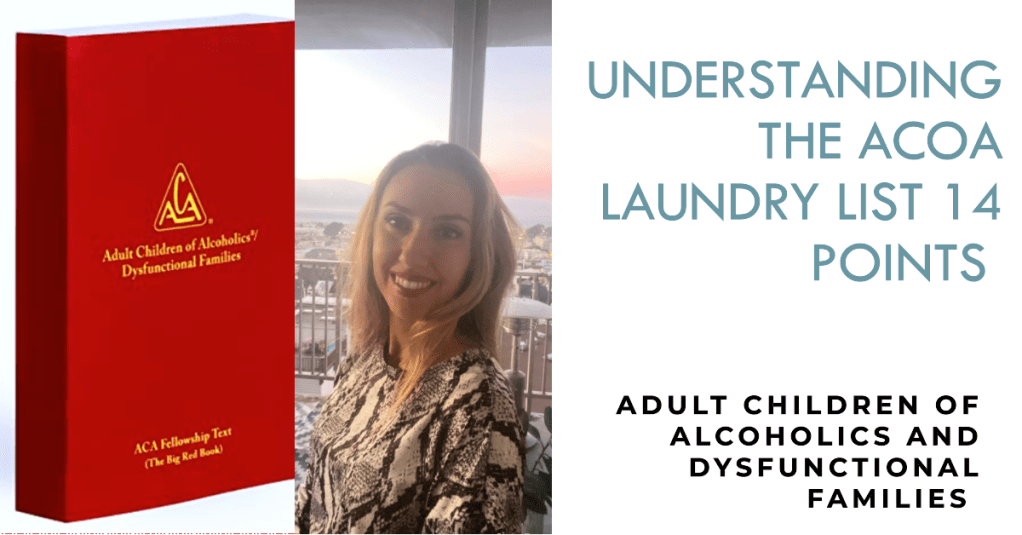
Hey there, fellow Adult Children of Alcoholics and those from less-than-ideal family backgrounds. I’m Dr. Sofya Vasilyeva (Vass), and welcome back to my psychology blog, your safe space for understanding relationships, navigating dysfunctional pasts, attachment styles, and more. In this post, I want to unpack the Laundry List – those familiar traits often found in individuals raised in alcoholic households. Let’s dissect each point, using the insights we explored in my recent YouTube video.
Origin and Significance:
The Laundry List, a compilation of characteristics commonly seen in those brought up in alcoholic families, is a vital aspect of the Adult Children of Alcoholics (ACOA) community. Crafted by Tony A., one of the pioneers of the ACOA movement, this list emerged in the early 1970s. It served as a revelation, connecting individuals in recovery through shared patterns rooted in their formative years.
Diving into the Points:
1. We become isolated and afraid of authority figures: This point delves deep into the fear that underpins this behavior. ACOAs often grapple with vulnerabilities and self-expression around others, leading to an isolating self-protective stance.I love that the word fear in in this sentence – because it’s not even so much about the fear for “authority figures” it’s really the fear of people in general. ACOAs often develop a protective bubble and weather they are social people or not, they tend to keep to themselves and have difficulty with self expression and fear of being “exposed”.
2. We become approval seekers and lose ourselves in the process: Losing one’s authentic self in a quest for approval is a coping mechanism, born out of fear and an ingrained habit of subservience and caretaking. This one relates to point one as well. Losing one self in order to maintain a certain appearance that the adult child would perceive to be likable by others is due to fears that they may become exposed and seen. This also can stem from a long standing habit of not being one self and taking care of others. It becomes habitual for many acoas to take care of others and to be in a more subservient role.
Also, I do want to point out that this is generally a normal human train. As we are meant to function as a part of the group some people will naturally take the stance of being in a supporting role, being more of a caregiver to others. Helping others and caring for others is adaptive and makes one a valuable member of the group. It becomes a problem when the energy given to others is not in balance to paying attention to one’s own basic needs. The tale tale sign of this being a problem is having no ability or poor ability to express one self and struggle as a result.
Paying attention to physical needs as well. I’ve heard many times ACOAs saying things like they have difficulty asking to use the bathroom for instance when on a long road trip with friends and holding it in, or feeling afraid to interrupt a friend while they’re speaking and almost peeing their pants. When even the most basic personal needs are disregarded sometimes, and that’s a sign that there is a mountain of other disregarded personal needs and feelings.
3. We are frightened by angry people and any personal criticism: The fear of anger, often buried in the subconscious, can shape relationship dynamics, pushing ACOAs into patterns of criticism and self-doubt. I love this point as well because it is amazing how frequently ACAOs end up with people who have no problem over-expressing their anger and how often ACOAs themselves express rage and while it is obvious to everyone else – the ACOAs feel that they “are not angry”. ACOAs are also often hypercritical of themselves and others and while they easily recognize how critical they are of themselves they don’t feel that they are of others, however it often comes out in the form of control of others and distrust. I love working with this presentation because connecting with anger is one of the most healing transformations that can occur for an individual.
4. We either become alcoholics, marry them, or find another compulsive personality: This point showcases the psyche’s tendency to seek familiarity, even if it leads to destructive patterns in partnerships. Obviously if you had grown up around alcohol it is only natural to partake. Many ACOAs however chose to not drink at all, but are attracted to the familiarity of the addictive energy in other people.
5. We live life from the viewpoint of victims: While not universal, some ACOAs struggle with feelings of being cheated or mistreated, a result of their difficulties in self-expression within relationships. Most ACOAs that I work with do not take a wholistic “victim” stance in life. Quite the opposite, many disregard their emotions and function in robotic ways taking on many responsibilities. However due to fears and difficulty with self expression, within the relationship dynamics ACOAs feel that they have the “short end of the stick” and this is due to trapped feelings of not being loved and respected that are projected in to other people as well as lack of ability to ask of needs to be met or even recognizing needs and being left with feelings of resentment over situations.
6. We have an overdeveloped sense of responsibility: While taking responsibility is positive, it becomes problematic when it hampers self-care and blocks you from living out your values and human potential. Taking on responsibility and helping others is an adaptive strategy when being with a group and it is a positive coping strategy to dis concern oneself with self centered needs and feelings and take on the responsibility of helping others. The question though is how useful are your endeavors and do they align with your values. Is there a purpose to your help? For example – you could be volunteering at an organization over the weekends – where your focus is directed on helping others rather than wallowing in your self centered problems and at the same time you’re around good people, making connections and hopefully feeling fulfilled. Or, you could feel responsible for your partners addictions for example and spend your time taking on responsibility of helping them get better -meanwhile, they are not making much of an effort to better themselves.
7. We get guilt feelings when we stand up for ourselves: Guilt surfaces as ACOAs assert themselves, tangled in the fear of self-expression and asserting boundaries. This one is in concert with point one, two and three. This has to do again with self expression and feeling confident enough to care for yourself and express your genuine thoughts and feelings. Fear of being exposed and standing in your own power.
8. We become addicted to excitement: Chaos becomes a comfort zone, often manifesting in addictive behaviors. Recognizing this, ACOAs can channel it positively. Yes, adult children oftentimes grow up in chaos, therefore, they are attracted to chaotic energies including personal addictions. It’s harmful when this energy is spent on addictive behaviors or people who are not a positive life force. However, being attracted to excitement is not inherently bad and in fact is a superpower. When I work with people, I like to take on the perspective of helping people see and accept their nature. For someone who’s addicted to excitement – what are some healthy ways of expressing that? Can that be in the form of a hobby – or learning new things, or finding an exciting industry to work in. How can you take a natural personality configuration and make it your superpower?
9. We confuse love and pity: Relationships built on pity are common, stemming from a fear of successful, happy individuals. Acknowledgment and redirection are key here. This stems from general fear of people, and low self esteem. The more vulnerable or struggling other individual are, the less feared, so there is a comfort if being around them. Ask yourself – how would you feel if your partner or friends were happy and successful and did not have major problems? Would it make you feel like an outsider or “less then”? Oftentimes when ACOAs look within, they find a sense of discomfort around being with people who are not struggling and that usually comes from feeling inadequate. Being in a helping role and care taking places one in a position of control over others and thus facilitating feelings of adequacy and being “needed”. This is also one of the dynamics of being an enabler as well, finding someone dependent and then unconsciously maintaining them in that position.
10. We have “stuffed” our feelings from our traumatic childhoods (Denial): Reconnecting with suppressed emotions is transformative, albeit challenging. It leads to a stronger connection with reality. This work is difficult and tumultuous there is no denying that, but of course very much worth the effort – on the other side, one would hopefully find a better connection with reality and an increased tolerance of various life situations.
11. We judge ourselves harshly and have a very low sense of self-esteem: Acknowledging the normalcy of these traits and finding their positive aspects is essential. It’s about embracing one’s uniqueness. Oftentimes when ACAOs find this list or some ACAO literature and first start identifying themselves in the writings and doing the work – their self esteem drops, and I personally believe that these laundry list points and some literature out there can be very daunting and really make people think – like wow! I really am messed up. Which is why I always try to point out that so many of these points actually constitute normal human behavior, and also there are superpowers behind each one – the person just usually needs some help to tap into those superpowers.
12. We are dependent personalities who are terrified of abandonment and will do anything to hold on to a relationship in order not to experience painful abandonment feelings, which we received from living with sick people who were never there emotionally for us. Fear of independence often stems from deep-seated insecurities. Recognizing these patterns can initiate the journey toward self-sufficiency. Some ACOAs have dependent personalities, while others are of course on the counter dependent spectrum. As far as dependency, most ACOAs are completely capable, more so than most people to be fully independent and self-sufficient. From an early age they learned how to cook, do their own laundry, got employed early on and so on. Unlike some dependent personalities who actually feel that they lack capability of taking care of themselves. However, yes, sometimes, due to fear of people and possibly a general fear of life, ACOAs usually find a partner to be dependent on and try to maintain that relationship at all costs. Losing relationships or people can seem absolutely unbearable. And also being dependent on someone is a comfortable position that is difficult to give up.
13. Alcoholism is a family disease; and we became para-alcoholics: Even without drinking, ACOAs exhibit traits of denial, control, and trust issues, shaped by the presence of alcoholism in the family.
14. Para-alcoholics are reactors rather than actors: Reacting emotionally to situations is common, given the overwhelming influence of the alcoholic’s behavior. Proactivity can be hindered, making it crucial to regain control over responses. When people live with alcoholics, they become overwhelmed and are influenced emotionally to the alcoholics behavior. So when the alcoholic comes home drunk for example, the reaction would be sadness, maybe aggression, provoking a conflict, followed by depression, grief and stress. To act would be to organize life with boundaries, and to work on protecting your own well being by engaging in healthy coping activities. Of course even in the acting strategy, one would still be affected emotionally by a family member who is drinking.
In Closing:
Understanding the Laundry List isn’t about self-condemnation; it’s about self-discovery and transformation. Remember, these traits, born from coping mechanisms, can be reshaped into strengths. Share your thoughts in the comments below, and if you need personalized guidance, consider reaching out for a session. Until next time, fellow travelers on the road to healing, take care!
 Resources for adult children of alcoholics
Leave a comment